Peyronie’s disease is a condition that affects the penis and may cause it to bend or curve during erection. The condition develops when scar tissue forms inside the penile tissue, leading to changes in shape, flexibility, and sometimes sexual function. While a mild curve may not cause problems, more significant curvature can create discomfort, difficulty during sexual activity, and emotional stress.
Many men feel embarrassed discussing intimate health concerns and often delay seeking information. Individuals living in areas such as Dwarka, Nagli, and nearby parts of Delhi may also ignore symptoms because they believe the condition will improve on its own. However, understanding Peyronie’s disease and available treatment options can help men make informed decisions about their health.
Peyronie’s disease occurs when fibrous scar tissue develops inside the penis. This scar tissue can affect how the penis expands during erection, leading to bending, shortening, narrowing, or changes in shape.
The condition may develop gradually or become noticeable after an injury or trauma to the penile tissue.
Symptoms vary from person to person and may become more noticeable over time.
Some men may also experience emotional stress due to changes in appearance or sexual function.
The exact cause is not always clear. However, several factors may contribute to the condition.
Repeated minor injuries during physical activity or sexual activity may lead to scar tissue formation.
Certain connective tissue conditions may increase the likelihood of developing scar tissue.
As men age, tissue healing may change, increasing the risk of scar formation.
Some individuals may have a family history that increases susceptibility.
Long-term inflammation may contribute to abnormal tissue healing.
The condition can affect more than just physical health.
Some men may experience:
Understanding the condition early may help improve treatment planning and long-term outcomes.
During this stage, curvature may continue to change and pain may be present.
The curvature becomes stable and pain often decreases. Treatment decisions are usually made after the condition stabilizes.
A detailed evaluation helps determine the severity of the condition and identify the most appropriate treatment approach.
A healthcare provider may ask about:
A physical examination helps identify scar tissue and assess penile structure.
Ultrasound may be used to evaluate scar tissue, blood flow, and penile anatomy.
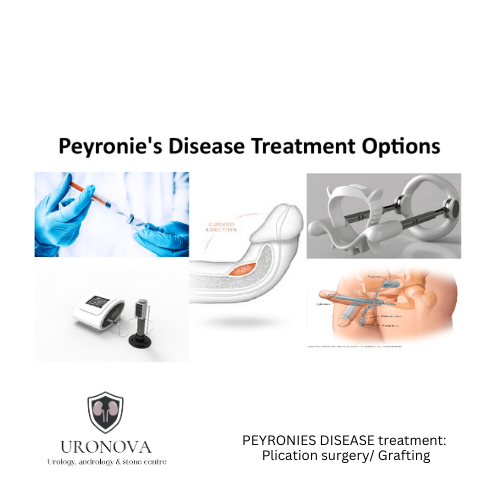
Treatment depends on symptom severity, degree of curvature, erectile function, and patient goals.
Mild cases that do not significantly affect daily life may be monitored over time.
Certain medications may be discussed to help manage symptoms in selected cases.
Healthy habits may support overall vascular and reproductive health.
Plication surgery is one of the surgical treatment options used for Peyronie’s disease.
This procedure is generally performed to straighten the penis by adjusting tissue on the side opposite the curvature.
Plication may be considered when:
The procedure aims to:
The suitability of surgery depends on individual evaluation and anatomy.
Grafting is another surgical approach used in selected cases of Peyronie’s disease.
Grafting involves correcting the curvature by addressing the scarred area and placing graft material where needed.
Grafting may be discussed when:
The procedure aims to:
Treatment decisions are made after careful evaluation of each patient’s condition.
Recovery time varies depending on the type of treatment performed.
Factors affecting recovery may include:
Following medical advice and attending follow-up visits can support recovery.
Many men hesitate to seek help because of embarrassment. However, early assessment may help identify the condition before symptoms become more severe.
Men from Dwarka, Nagli, and nearby areas of Delhi often search for information about penile curvature and Peyronie’s disease when it begins affecting confidence or sexual health. Timely evaluation may help provide appropriate guidance and treatment options.
Maintaining good overall health can support reproductive wellness.
These habits may support blood circulation and long-term sexual health.
Location:- PILLAR NUMBER 63, PLOT NO 3, below NANGLI METRO STATION, Ranaji Enclave, Masudabad, Najafgarh, New Delhi, Delhi, 110043
Location:- Vandematram apartments, 46a, Pocket 2, Sector 6 Dwarka, New Delhi, Delhi, 110075